Unification of Japan and the Bakuhan System
- Dylan Day

- Sep 17, 2025
- 8 min read
The Unification of Japan refers to the process in the 16th and early 17th centuries by which Japan, long divided among feudal lords (daimyōs) and riven by civil war, was gradually brought under centralised control — eventually resulting in over 250 years of peace under the Tokugawa shogunate. The political structure that the Tokugawa established to maintain this order is often called the Bakuhan system (幕藩体制, Bakuhan Taisei), combining bakufu (幕府, military government or shogunate) and han (藩, the domains governed by each daimyō).
You can learn more about the history of Japan with this free MIT course: Modern Japan, 1868 to present - https://ocw.mit.edu/courses/21h-155-modern-japan-1868-to-present-spring-2017/
Setting the Stage: Muromachi Period & the Warring States (Sengoku) Era
The Muromachi Period (also known as the Ashikaga shogunate) lasted roughly from 1338 to 1573. The Ashikaga family ruled from Kyoto (in the Muromachi district) under a shōgun with somewhat weak central authority. Many local lords (daimyōs) held real power in their provinces.
By the mid-1400s, after the death of an Ashikaga shōgun, there was a civil war; different factions of the family and their allies split, and local warlords began to fight among themselves more or less independently.
This period of fragmentation is often called the Warring States (Sengoku) era. Daimyōs built castles, fought battles for land, formed shifting alliances, etc.
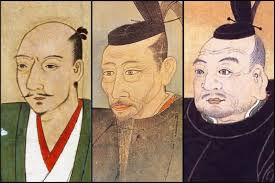
The Three Great Unifiers
Here's how the unification unfolded, through three major figures:
Born into the Oda clan in Owari Province (modern Aichi) in 1534.
He was the first of the “Great Unifiers.” His strategy combined military innovation (including the use of firearms), ruthless suppression of rivals, and political reforms that undermined older institutions like certain Buddhist temples which held military power.
One famous victory was the Battle of Okehazama (1560), where Oda Nobunaga defeated a much larger force under Imagawa Yoshimoto, surprising the enemy and gaining prestige and territory.
He took control of the Tōkaidō route, among other key areas, encouraging freer trade along those routes.
Nobunaga’s rule was cut short by betrayal: in 1582 he was betrayed by one of his generals, Akechi Mitsuhide, and died during the Incident at Honnō-ji.
Started life from very humble origins (some sources say a peasant’s son) in Owari Province. He entered Oda Nobunaga’s service (originally as lower rank, rising through merit and connections).
After Nobunaga’s death, Hideyoshi moved quickly: he made peace with powerful enemies, then defeated rival claimants. He completed (or very nearly completed) the territorial unification begun by Nobunaga by around 1590.
Hideyoshi introduced several important reforms: a rigid class system that separated samurai, peasants, artisans, and merchants; disarming peasants (so only samurai could bear arms); land surveys; and regulation of movement of people and the ownership of land.
He also attempted foreign expansion (notably invasions of Korea) but these ended up draining resources and did not succeed in creating long-term gain.
Tokugawa Ieyasu (1543-1616)
Born Matsudaira Takechiyo in 1543, he eventually allied himself with Nobunaga, and then after Nobunaga’s death worked closely with Hideyoshi.
After Hideyoshi died in 1598, there was a power vacuum. This culminated in the Battle of Sekigahara (1600), in which Ieyasu defeated rival lords and became the de facto supreme power in Japan.
In 1603, the Emperor officially appointed him Shōgun, giving him the legal authority to rule on behalf of the Emperor—but in practice giving him centralized military and political power. He established his capital at Edo (modern Tokyo).
His successors, notably his son Tokugawa Hidetada and grandson Tokugawa Iemitsu, consolidated the institutions of rule, embedding laws and systems to ensure stability.
“Bakuhan” comes from bakufu (military government or shogunate) + han (domains). The system is a power‐sharing / balancing arrangement: the shogunate has strong central powers, while local daimyōs control their domains under certain constraints. Important features:
Domains (han): Each daimyō ruled a domain, with certain lands, revenues, samurai vassals, etc. But domains were not fully independent; they owed obligations to the shogunate.
Bakufu: The shōgun’s government, based in Edo, which regulated things like national law, foreign policy, large‐scale infrastructure, currency, official appointments, etc.
Warrior Law / Military Code: Laws such as the Buke Shohatto (Laws for the Military Houses) regulated the behavior of the samurai, daimyōs, and their relations with each other and with the shogunate.
One Castle per Domain Rule: To limit the military threat of daimyōs, often they were limited in how many fortified castles they could maintain.
Oath of Loyalty: Daimyōs had to swear loyalty to the shōgun; their status depended on service, obedience, non-interference, etc.
Samurai as Bureaucrats: Over time, especially in peacetime, many samurai moved from purely military functions to administrative roles governing domains and carrying out shogunate orders.
Control of Imperial Court: The Emperor and the court in Kyoto were kept under tight control by the shogunate; while they remained symbolic figureheads, real authority was wielded from Edo.
Standardisation: Measurements, weights, currency (allowed under Iemitsu and others), and economic regulation (e.g. the value of koku – a unit of rice productivity used as measure of wealth and of domain size) were standardised.
Religion, Ideology, and Social Order
These were also crucial to how the unification and the Tokugawa order held together.
Christianity was initially welcomed or tolerated by figures like Nobunaga (who saw it as a possible counterweight to powerful Buddhist institutions). Hideyoshi later banned or restricted it. Iemitsu and later shoguns persecuted Christians, culminating in the Shimabara Rebellion (1637-38) where Christian peasants revolted, which was crushed.
Buddhism and Shinto: The Tokugawa regime promoted Buddhism (often temple registration was required) and Shinto as part of state ideology, with the imperial cult and shrines playing a role. Temples also helped in social control (people registering there, etc.).
Social status system: The four main classes (often stated as samurai (warriors), peasant farmers, artisans, merchants) were strictly defined, with legal and social rules about what each class could and could not do. Movement between classes was severely limited.
Consolidation & Consequences
With Ieyasu’s victory at Sekigahara and his becoming shōgun in 1603, the foundations for long-term peace and order were laid. His successors codified many of the laws that bound daimyōs to the shogunate, restricted foreign influence, and structured economy and society in ways that preserved stability.
The system brought internal peace (no large civil wars), city growth (Edo becomes huge), development in commerce, culture, infrastructure, etc. Urban life flourished.
However, it was also rigid: social mobility was limited; economic hardship under heavy taxation or weak domain management could occur; foreign isolation meant slower uptake of foreign scientific and technological innovation (until much later).
There were also cases of “samurai disorder” – famous stories such as the Forty-Seven Ronin (1701-1703) illustrate how the values of loyalty, family honour (ie), and duty remained strong, and sometimes led to conflict within the system of obligations. (Though sources are sometimes uncertain or legendary.)
Key Laws and Policies
Some of the critical laws / administrative moves:
Warrior Law Code (Buke Shohatto): rules for the samurai houses.
One Castle per Domain: to prevent daimyō from building up too much military strength.
Standardisation of koku: used to measure a domain’s wealth; political status often depended on how many koku one controlled.
National currency introduced (under Iemitsu) and control over weights, measures etc.
Tokugawa Iemitsu and the Maturation of the System
Tokugawa Iemitsu (r. 1623-1651) was the third shōgun. He further strengthened the system: he implemented the strict sakoku (“closed country”) policy, banning nearly all foreign contact, limiting trade to certain ports (especially Nagasaki), and enforcing anti-Christian laws.
Iemitsu also oversaw centralisation of power, ensuring that the Emperor and court had symbolic rather than practical power.
Name | Dates | Background / Rise | Key Achievements | Weaknesses / Limits |
Oda Nobunaga | 1534-1582 | Daimyō from Owari province; ambitious, ruthless; adopted firearms; challenged both religious and feudal institutions. | Took over Ashikaga shogunate’s nominal authority, controlled many provinces, opened trade, broke power of militant Buddhist sects; set up groundwork for centralisation. | Did not live to complete unification; was betrayed; some of his methods were brutal and provoked resistance. |
Toyotomi Hideyoshi | 1537-1598 | Started low-born, rose through military service under Nobunaga; excellent administrator and political negotiator. | Completed unification (all or almost all of mainland Japan under a single ruler), instituted social structure, land surveys, control over daimyō, promoted culture; attempted Korean invasions. | His succession was weak (his heir was young), foreign campaigns failed, some of his oppressive measures made discontent possible. |
Tokugawa Ieyasu | 1543-1616 | Daimyō with cautious, long-term strategy; made alliances; survived dangerous times; won Sekigahara. | Became shōgun, established the Tokugawa shogunate; built durable institutions; ensured peace; set up Edo as centre; system would endure for over 250 years. | Often conservative; some suppression (religious, liberties) and isolation which later made Japan slow to adapt to external pressures; also some daimyō discontent remained. |
The Unification of Japan: Chronology (Selected Key Events)
Mid-1500s: Muromachi shogunate weakens; regional daimyōs fight over land and power.
1560: Battle of Okehazama – Nobunaga defeats Imagawa Yoshimoto.
1570s–1580s: Nobunaga expands power; introduces reforms; then dies (1582).
1582-1590: Hideyoshi consolidates control; defeats rival daimyōs; completes (to practical degree) unification of lands.
1598: Hideyoshi dies; Toyotomi heir is young; factions form.
1600: Battle of Sekigahara – decisive victory for Ieyasu.
1603: Ieyasu appointed shōgun; establishment of Tokugawa shogunate.
Early 1600s-1630s: Laws, institutions, and policies of the Bakuhan system are put in place; anti-Christian edicts, national seclusion, central control strengthened.
The Consequences of Unification & Bakuhan
Peace and Stability: After centuries of conflict, the Tokugawa era (also called the Edo Period, 1603-1868) is marked by internal peace (no major civil wars) and order.
Urbanisation and Culture: Cities like Edo grow massively; culture blossoms (arts, literature, theatre, etc.).
Economic Growth and National Economy: More systematic taxation, standardisation, stable domains, control of trade. Domestic commerce improves.
Rigid Social Structures: The strict class system limits mobility; peasants, artisans, merchants are regulated; samurai are elevated but with obligations.
Isolation from Foreign Influence: With sakoku and anti-Christian policies, Japan turns inward, which helps maintain political stability but also limits exposure to external scientific, technological, and political ideas (until the 19th century).
Legacies and Tensions: Over time, some han (domains) become wealthy and begin chafing at restrictions; peasant uprisings occur; the system which depended on close control gradually comes under stress, especially when encountering Western powers in the 19th century.
Definitions of Key Terms
Daimyō: A feudal lord, ruler of a domain (han), with samurai retainers, responsible for local governance, taxation, military service.
Samurai: The warrior class, serving under daimyōs or the shōgun; had privileges but also obligations; over time many samurai became bureaucrats.
Shōgun: Military ruler; de jure the commander of military forces appointed (or recognized) by the Emperor, but in practice the political ruler under the Tokugawa.
Bakufu: The shogunate government – central military-government under the shōgun.
Han: The individual domains ruled by daimyōs.
Koku: A unit of measure of rice (roughly the amount to feed one person for a year), used as a standard of wealth/production of a domain.
Sakoku: The “closed country” policy restricting foreign contact and trade, forbidding nearly all overseas travel by Japanese, etc.
Buke Shohatto: The laws for the military houses; a code that regulated behavior of daimyōs, samurai, etc.
Further Reading & Links
Here are some essays, articles, and book suggestions if you want to explore in more depth:
"The Cambridge History of Japan”
Gluck, Carol. “The Invention of Edo.” Chapter 17 in Mirror of Modernity: Invented Traditions of Modern Japan. Edited by Stephen Vlastos. University of California Press, 1998.
Ōishi Shinzaburō. “The Bakuhan System.” Chapter 1 in Tokugawa Japan: The Social and Economic Antecedents of Modern Japan. Edited by Nakane Chie and Ōishi Shinzaburō, University of Tokyo Press, 1992.
Conclusion
The Unification of Japan was not the work of one man alone, but a successive, overlapping process carried forward by Nobunaga, Hideyoshi, and Ieyasu. Each built upon what came before: from military conquest, to social reform, to institution-building.
The Bakuhan system was the result: a carefully balanced political arrangement that held together coercive and incentive-based controls (military, legal, economic, religious) to maintain peace, stability, and order, while limiting local autonomy enough to prevent rebellion but allowing daimyōs enough power to administer their domains.
For those new to the subject, understanding the unification and Bakuhan system is key to understanding how early modern Japan was structured, and how its long peace (the Edo period) was possible – as well as why Japan had difficulty with outside pressures until the mid-19th century.
You can also learn more about the following Meiji Era here.

![[To Investigate] How American Citizenship was Performed by Japanese Americans Interned at Tule Lake Incarceration Camp Following the Loyalty Questionnaire](https://static.wixstatic.com/media/c9a585_20ed25a1971c405a9d29b60fed939b8d~mv2.png/v1/fill/w_476,h_336,al_c,q_85,enc_avif,quality_auto/c9a585_20ed25a1971c405a9d29b60fed939b8d~mv2.png)

Comments